

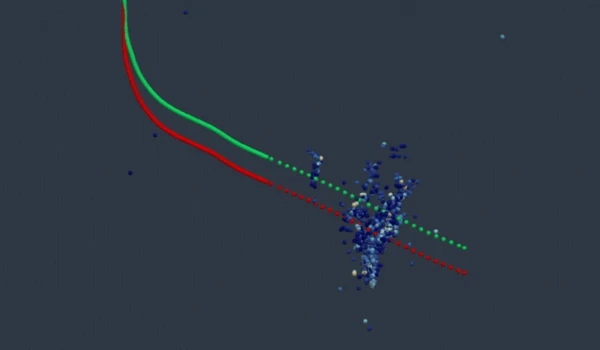
Beneath the Utah desert, two wells drilled into granite at a depth of 2,500 meters have just demonstrated what the geoscience community has been waiting for over decades. This result is the product of careful analysis of geological and geophysical data accumulated over the years.
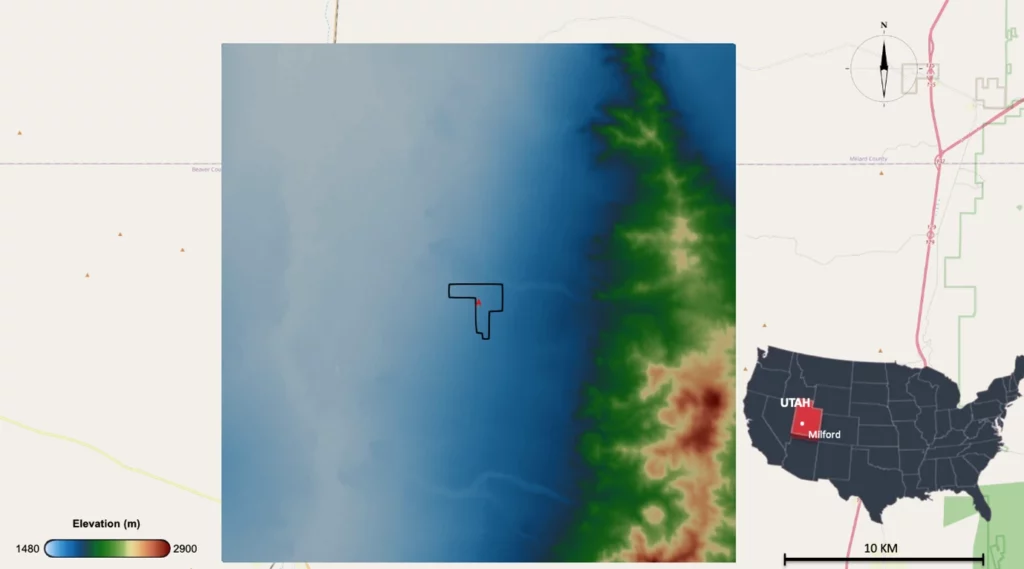
2D view and topography of the Utah FORGE site (Milford, Utah, USA). The black outline delimits the study area. The high-altitude zone to the east corresponds to the Mineral Mountains, whose western flank hosts the hot granite pluton targeted by the project.
In 2014, the U.S. Department of Energy issued a call for proposals to create a field laboratory dedicated to Enhanced Geothermal Systems (EGS). The concept involves drilling into hot rocks such as granite, then injecting water under pressure to reopen natural micro-fractures and create a heat exchanger at depth. A second well then recovers the water heated by contact with the rock. Where conventional geothermal energy depends on rare volcanic zones, EGS theoretically enables extraction of Earth’s heat almost anywhere.
After evaluating five sites across the American West, Milford, Utah was selected. The western flank of the Mineral Mountains hosts a Tertiary granite pluton: a body of crystalline rock formed between 25 and 8 million years ago, still very hot today.
Exploring Data Before Drilling
Three geophysical surveys provided decisive information. Gravity surveys delineated the lateral extent of the granite pluton at the surface through its negative Bouguer anomaly. Granite is less dense than surrounding rocks, resulting in a slightly lower gravitational pull above it. Magnetotellurics imaged the subsurface electrical resistivity. Dry crystalline granite appears above 1,000 Ω·m from approximately 1,500 meters depth, while conductive fault zones stand out as targets to exploit. The World Stress Map provided the orientation of maximum horizontal stress in the region (approximately N15°E), dictating optimal well angles to intersect fractures perpendicular to minimum stress.
Regarding the thermal resource, historical well 58-32, drilled in the 1970s, recorded 138°C at 2,300 meters before reaching the granite. This exceptional gradient is approximately twice the global average (25–30 °C/km, USGS 2012 ou 2008).
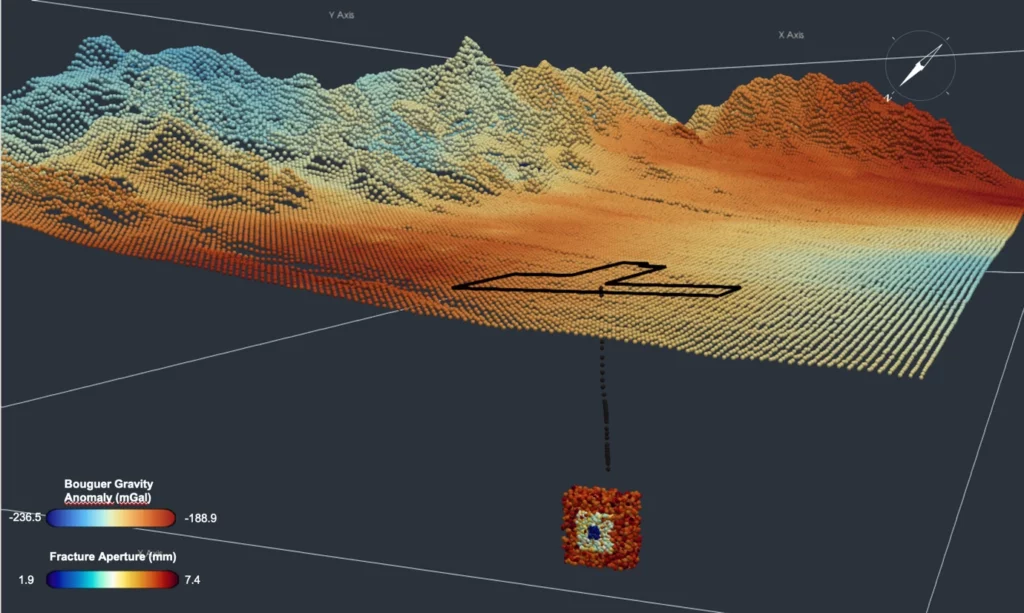
3D view of the Utah FORGE site: Bouguer gravity anomaly (colored surface), Discrete Fracture Network from well 58-32 (cubes colored by fracture aperture), and trajectory of exploration well 58-32.
The Discrete Fracture Network (DFN) is a 3D numerical model of the natural fracture network of the reservoir. It was built from FMI (Formation Micro Imager) data acquired in pilot well 58-32: by imaging the borehole wall over 360°, this tool identified each natural fracture with its orientation, dip, and density. From these real measurements, fractures were then statistically extrapolated across the entire reservoir volume.
Combining gravity data and the Discrete Fracture Network (DFN) model provided a precise map of the subsurface: where the most open fractures are located, their orientations, and their connectivity at depth. This integrated approach guided the exact trajectory and angling of wells 16A and 16B.
Monitoring Data During Drilling
Two directional wells, 16A(78)-32 and 16B(78)-32, were drilled at calculated angles to diverge in the reservoir zone at approximately 2,500 meters. Starting in April 2024, well 16A underwent hydraulic stimulation in eight distinct stages over two weeks. Water was injected at high pressure while seismic sensors recorded microfractures and mapped reservoir growth in real time.
During stimulation, well 16A generated 2,662 microseismic events compared to 239 for well 16B. This asymmetry indicates that 16A was significantly more effective at reactivating natural fractures, targeting favorably oriented fracture families. The spatial distribution of hypocenters (between 1,884 and 2,838 meters depth) clustered along natural fracture planes predicted by the DFN model. This microseismic cloud provides a direct scan of the stimulated reservoir. Low-magnitude events confirmed that stimulation remained controlled and predictable.
In August and September 2024, Utah FORGE conducted its extended circulation test. Water injected into 16A circulated through the stimulated fracture network and was recovered in 16B at a downhole temperature of 188°C. More than 90% of the injected fluid was recovered, with flow rates reaching up to 420 gallons per minute (approximately 1,600 L/min). For the first time, an EGS system demonstrated sustained inter-well connectivity and heat extraction in a rock with no pre-existing natural permeability.
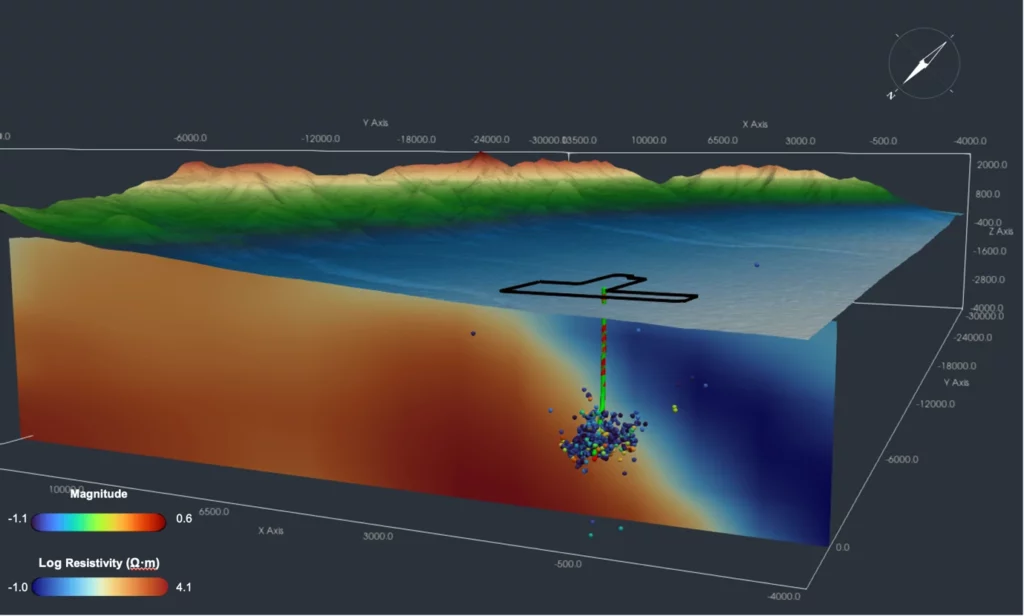
3D visualization combining magnetotelluric resistivity, well trajectories, and microseismicity. Microseismic events cluster precisely at the interface between the resistive zone (dry granite) and the conductive zone (fluid-saturated fractures).
Interpreting Data After Drilling
Displaying magnetotelluric resistivity, well trajectories, and microseismicity together reveals something that none of these datasets would show individually. Microseismic events do not distribute randomly within the granite: they cluster exactly at the interface between the resistive zone (dry crystalline granite) and the conductive zone (fluid-saturated fractures). It is precisely at this transition that fractures were reactivated under injection pressure.
Surface geophysics and induced seismicity tell the same story.
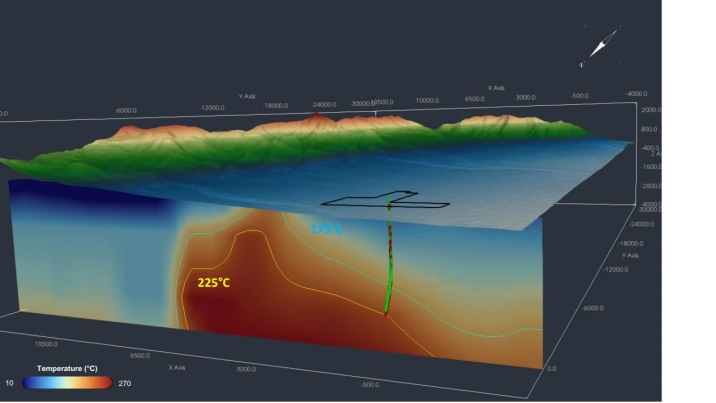
Direct downhole measurements confirm the site’s exceptional geothermal gradient, from surface to −4,000 m.
What the surface suggested, drilling confirmed directly: by combining topography, measured well temperatures, and well trajectories, the site’s exceptional geothermal gradient becomes immediately visible. Heat concentrates exactly at the foot of the Mineral Mountains, where the hot granite pluton rises to within 2,500 meters of the surface precisely where the wells were sited.
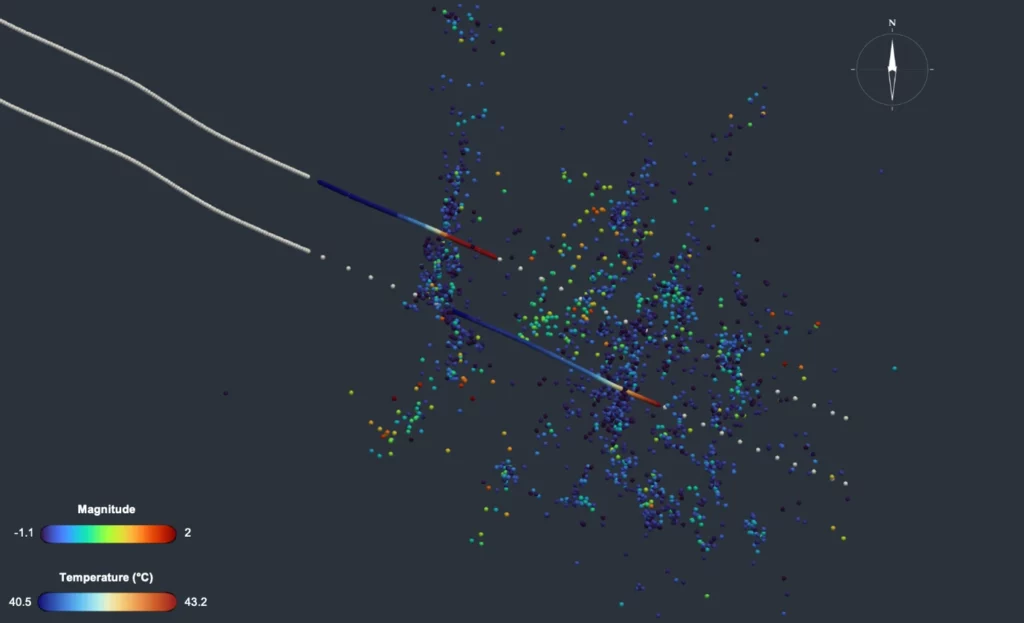
Spatial correlation between temperature profiles and microseismicity between wells 16A and 16B. Microseismic events concentrate where temperature is highest, mapping the active heat-exchange zone.
Combining well temperature profiles with the spatial distribution of microseismicity reveals a direct correlation: seismic events concentrate where temperature is highest, in the rock volume between 16A and 16B. This event cloud does not describe a simulation; it maps the reservoir as it exists, stimulated and connected. Heat and fracturing are in the same place: the necessary condition for an EGS system to work.
Outlook
The 30-day test in 2024 represents a major milestone. Next, Utah FORGE plans an extended circulation test of approximately 90 days to evaluate long-term behavior: thermal drawdown, fluid loss, scaling, and corrosion risks. This data is essential for sizing future commercial EGS projects capable of reliably producing over several decades. Drilling a third deviated well is also under study to test alternative geometry configurations. With U.S. Department of Energy (DOE) funding secured through 2028, FORGE continues to establish benchmarks for commercial-scale EGS.
Significance of the Breakthrough
The technically recoverable EGS potential in the United States exceeds 5 terawatts – five times the nation’s current electrical capacity. Globally, the resource is vast due to the universal nature of geothermal gradients. Utah FORGE demonstrates that integrating gravity, magnetotellurics, DFN modeling and microseismic monitoring enables the predictable design of functional EGS reservoirs. Replicating this approach across diverse geological settings offers a viable pathway for baseload renewable energy.
Explore FORGE Data for Free via EarthSight™
By downloading the free pilot version of EarthSight™ software (version 0.2.0), a FORGE demo project is automatically installed. You can display the wells trajectories, temperature profiles, microseismicity, and magnetotelluric resistivity in 3D.
All data generated by the Utah FORGE site are publicly available via the Department of Energy’s Geothermal Data Repository (GDR, https://www.gdr.openei.org/). Visualizations in this study were rendered using EarthSight™ software.
References
Cariaga, C. (2026). Carrying on the legacy of geothermal innovation at the Utah FORGE project. ThinkGeoEnergy.
Heidbach, O. et al. (2018). The World Stress Map Database Release 2016: Crustal stress pattern across scales. Tectonophysics, 744, 484–498.
Moore, J. et al. (2024). Geology of the Utah FORGE EGS Site. Journal of Volcanology and Geothermal Research, 449, 107850.
Norbeck, J. et al. (2024). Hydraulic stimulation and circulation testing at the Utah FORGE Enhanced Geothermal Systems field laboratory. Geothermics.
U.S. Geological Survey (2008). A review of methods applied by the U.S. Geological Survey in the assessment of identified geothermal resources. USGS Open-File Report 2008-1296.
Utah FORGE (2024). Utah FORGE Successfully Completes Stimulation and Circulation Tests. Press Release.